Most people don’t see this one coming.
You spend 30 or 40 years building relationships at work — with colleagues, clients, managers, teammates. Some of those relationships feel genuinely close. Real friendships, not just professional ones.
Then you retire. And within a year or two, a surprising number of those connections have quietly faded.
Not because anyone did anything wrong. Not because the relationships weren’t genuine. But because they were built on proximity and shared context — the office, the industry, the daily grind — and when that context disappears, the relationships often do too.
For a lot of retirees, this is one of the loneliest surprises of the whole transition.
Why Work Friendships Fade
It’s worth understanding the mechanism here, because it’s not personal.
Most adult friendships are built on what researchers call “passive contact,” repeated, low-effort interaction that happens because you’re in the same place doing the same things. Work is the single biggest source of this for most working adults.
You see your colleagues every day. You share frustrations, inside jokes, small wins. The relationship builds naturally, without anyone having to work at it.
Retire, and that passive contact vanishes. Staying connected now requires active effort: making plans, following up, being intentional. And for relationships that were mostly built on convenience, that effort often doesn’t happen.
This isn’t cynical. It’s just how adult social life works. And understanding it helps you respond to it more effectively than just feeling vaguely hurt that people didn’t call.
The Loneliness Risk Is Real
It’s worth being direct about this.
Loneliness among older adults is genuinely common, and its effects go well beyond feeling sad. The National Institute on Aging links social isolation to higher rates of depression, cognitive decline, heart disease, and premature death. The health impact of chronic loneliness is comparable, in some studies, to smoking.
This isn’t meant to alarm. It’s meant to make the case that rebuilding your social life after retirement isn’t a soft, nice-to-have project. It’s a health decision.
What You’re Actually Rebuilding
The goal isn’t to replace your work friendships one-for-one. It’s to rebuild the underlying things those friendships provided:
Regular contact with people you like. Not once-in-a-while lunches. Recurring, reliable connection.
A sense of belonging. Being part of something — a group, a community, a cause — where people know you and expect to see you.
Relationships built on shared experience. The deepest friendships are built on doing things together over time. That applies in retirement just as much as it did at 30.
The good news is that all of these are buildable. They just don’t happen passively anymore.
Where to Actually Find People
This is where a lot of retirees get stuck. They understand they need more social connection. They don’t know where to start.
A few places that consistently work:
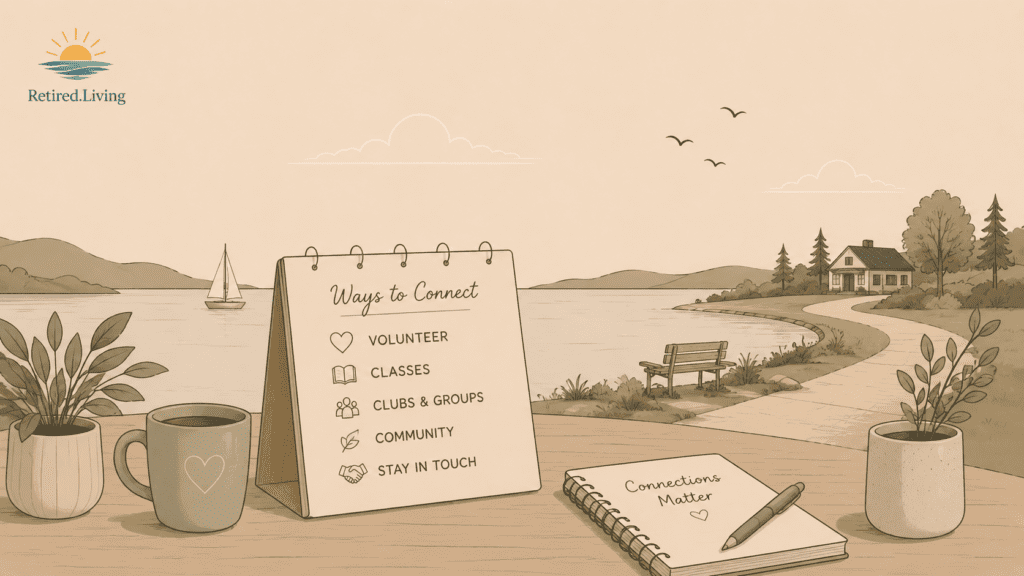
Volunteer work. One of the most underrated social environments in retirement. You’re around people regularly, you share a purpose, and relationships build naturally. AmeriCorps has resources for finding opportunities.
Classes and learning environments. A cooking class, a language course, a photography workshop. Structured settings with recurring attendance are friendship incubators.
Clubs and interest groups. Golf, hiking, book clubs, gardening, woodworking — whatever you’re into, there’s likely a group for it. Meetup.com is a decent starting point, as is checking with your local parks and recreation department.
Religious or spiritual communities. For those who are involved, this often becomes a primary social anchor in retirement.
Part-time work. For some retirees, a few hours a week of work — even casual or low-stakes work — keeps them connected and engaged in ways that are hard to replicate otherwise.
The pattern across all of these: recurring contact in a shared context. That’s the formula. You’re not trying to make instant friends. You’re creating the conditions for friendships to develop.
Don’t Neglect the Friendships You Already Have
It’s easy to focus on building new connections and let the existing ones coast.
But the friends you already have, the ones from before work or outside of work, are worth investing in seriously. These are often the most resilient relationships in your life, because they weren’t built on proximity.
Be intentional. Make plans. Show up. Be the one who initiates.
This is true for your marriage or partnership too, if you have one. Retirement puts you both home all day, often for the first time in decades. That’s a significant adjustment that deserves actual conversation: about space, routines, how you each want to spend time, and what you want to do together versus separately.
Here’s the Catch
Rebuilding a social life takes longer than most people want it to.
Making a new friend as an adult, a real one, not just an acquaintance, typically takes months of regular contact. Research from the University of Kansas suggests it takes roughly 50 hours of time together to move from acquaintance to casual friend, and 200 hours to develop a close friendship.
That’s not discouraging. It’s just honest. You’re not going to fix social isolation in a month.
What it means practically: start earlier than you think you need to. Don’t wait until you’re lonely to start building. The best time to work on your social life in retirement is before you actually need it.
The Practical Takeaway
The social life you had at work isn’t coming back. That’s okay. What you build next can be better: more intentional, more aligned with who you actually are now.
But it won’t build itself.
Pick one or two recurring activities that put you around people regularly. Invest in the friendships you already have. Give it time. Be the one who reaches out.
The retirees who thrive socially aren’t usually the most naturally outgoing people. They’re the ones who take it seriously.
Related on Retired.Living: