Nobody tells you this before you retire: unstructured time is harder than it sounds.
The idea of having “nowhere to be” feels like the whole point. And for the first few weeks, it usually is. Sleep in. Linger over coffee. Do whatever you want.
Then, somewhere around week three or four, a funny thing happens. The freedom starts to feel a little hollow. Days blur together. You’re busy, sort of, but not in a way that feels satisfying. The week just kind of… happens to you.
This isn’t a personal failure. It’s a structural one. And the fix is simpler than most people think.
Why Structure Matters More Than You’d Expect
Work did something for you that had nothing to do with your job description.
It organized your time. It gave Monday a different feel than Friday. It handed you a reason to get up, get dressed, and be somewhere. It created a rhythm — not always one you loved, but a rhythm.
When that disappears, most people don’t replace it with something better. They replace it with nothing. And nothing, it turns out, is not as restful as advertised.
Research backs this up. A growing body of research shows that retirees who maintain regular routines report higher life satisfaction, better mental health, and even better physical health than those who don’t. The structure itself seems to matter, not just what fills it.
(If academic research is more your thing, this paper in the American Journal of Biomedical Science & Research — Retirement: A Gateway to Fulfillment or Pitfall-The Crucial Role of Vision, Rituals, Nutrition, Planning, and Routines — is interesting.)
The Goal Isn’t a Packed Schedule
Before you start color-coding a calendar, let’s be clear about what good structure actually looks like.
It’s not busyness for its own sake. It’s not recreating your work schedule with different activities. And it’s definitely not filling every hour so you don’t have to think.
Good retirement structure is more like a loose framework — a week with enough shape that you know what you’re doing and why, but with plenty of room to breathe.
Think of it as anchors, not a timetable.
Building Your Week: The Anchor Approach
An anchor is a recurring commitment that gives a specific day or time a consistent identity. It doesn’t have to be long or elaborate. It just has to be real.
A few examples:
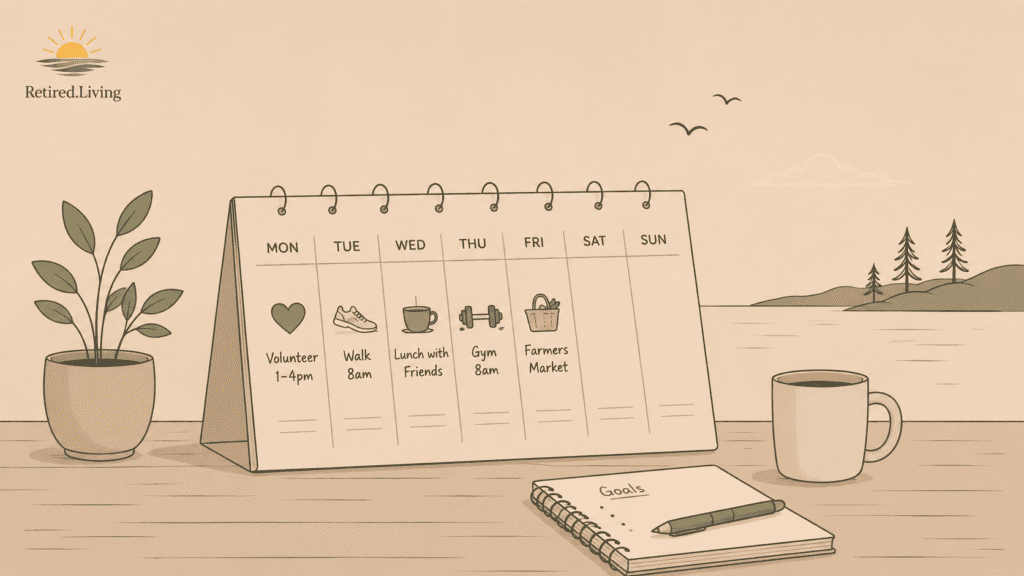
- Tuesday and Thursday mornings: gym or walk
- Wednesday lunch: standing plans with a friend or spouse
- Monday afternoons: volunteer shift
- Friday morning: farmers market or errands
That’s it. Four or five anchors like these, spread across the week, and your days stop feeling interchangeable. You have things to look forward to. You have variety without chaos.
Layer in the things you actually want to do (the hobbies, the travel, the projects, the grandkids) and you’ve got something that works.
The Three Categories Worth Filling
When thinking about how to structure retirement time, it helps to think in three buckets:
Things that keep you healthy. Physical activity, sleep habits, regular meals. These aren’t optional extras — they’re the foundation everything else rests on. Build them in first.
Things that connect you to other people. Social time. Regular contact with friends and family. Involvement in a group, club, cause, or community. This one tends to get underestimated and then regretted.
Things that give you a sense of purpose or accomplishment. A project. A skill you’re building. Something where your effort actually moves something forward. It doesn’t have to be grand. It just has to matter to you.
A week that has something from all three categories is a week that tends to feel full in the right ways.
Here’s the Catch
Structure is personal.
What works for someone who thrives on routine will feel suffocating to someone who values spontaneity. What feels “busy enough” for one person feels empty to another. There’s no universal template.
This is also worth saying: the first year of retirement is often an experiment. You’ll try things that don’t stick. Commitments you thought you’d love won’t pan out. Hobbies you’d put off for years might not be as satisfying as you imagined.
That’s fine. The goal in year one isn’t to get it perfect. It’s to stay curious and keep adjusting.
The retirees who struggle most are often the ones who either (a) refuse to plan anything and wait for fulfillment to show up on its own, or (b) over-schedule themselves immediately to avoid feeling the discomfort of transition.
Both are avoidance strategies. Neither works long-term.
A Few Things That Help Early On
Give it time. Most people need six months to a year to find a rhythm that actually fits them. Don’t judge the whole chapter by the first few weeks. (Honestly, it took me the better part of two years.)
Be intentional about mornings. The start of the day sets the tone. A consistent morning routine, even a simple one, tends to anchor everything else.
Build in variety. Same thing every day gets old fast. Mix solo time with social time. Active days with slower ones. Indoors and outdoors.
Don’t wait to be invited. Especially for social connection: make the plans. Be the one who reaches out. Passive retirement tends to be lonely retirement.
Review and adjust. Every few months, take an honest look at whether your week is working. Not against some ideal standard, just against how you actually want to feel.
The Practical Takeaway
You don’t need a full schedule. You need a framework.
Pick three to five anchors for the week. Make sure your week has something for your health, your relationships, and your sense of purpose. Expect it to take time to figure out. Adjust as you go.
The blank calendar isn’t the dream. A week you’ve actually designed, one that reflects what you value and how you want to live, that’s closer to it.
Related on Retired.Living: