
Most retirement planning focuses on the numbers — savings, income, Medicare, Social Security. And those things matter. A lot.
But there’s another side of retirement that catches people completely off guard.
Not the financial side. The human side.
The empty calendar. The quiet house. The slow realization that the structure, the purpose, and the daily rhythm you’ve had for 30 or 40 years is just… gone. That transition, even when it’s wanted, even when it’s earned, can hit harder than most people expect.
Here’s what’s actually going on, and what helps.
The Calendar Problem
Your first week of retirement might feel like a vacation.
The second week, a little less so.
By week three or four, a surprising number of retirees describe the same thing: a creeping sense of “what now?” The calendar that used to fill itself (meetings, deadlines, commitments, obligations) now sits blank. And blank doesn’t always feel like freedom.
It can feel like drift.
This isn’t a sign something went wrong. It’s a sign that structure was doing more work than you realized. Work didn’t just fill your time — it organized your time. Without it, days can blur. Weeks can too.
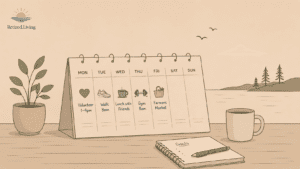
The fix isn’t to stay busy for the sake of being busy. It’s to rebuild structure intentionally. That could mean scheduled activities, volunteer commitments, a regular workout routine, a standing lunch with friends. What matters less than the specifics is that your week has shape again — anchors that give Monday a different feel than Saturday.
What You Lose When You Leave Work
Here’s something worth sitting with.
For most people, work provides five things that have nothing to do with income:
- Identity. “I’m an engineer.” “I’m a teacher.” “I run the eastern region.” That’s not just a job description. It’s a piece of how you understand yourself.
- Structure. As we just covered. Your day had a shape.
- Social connection. Coworkers, clients, colleagues. People you saw regularly, even if you didn’t socialize outside of work.
- Purpose. Something to accomplish. Problems to solve. A reason to show up.
- Sense of accomplishment. Projects completed. Goals met. Recognition, formal or informal, that you did something that mattered.
Retirement doesn’t replace any of these automatically. You have to rebuild them, consciously and deliberately, or the absence will fill in with something less useful. Restlessness. Irritability. A vague sense that something is off.
A lot of retirees describe this without quite naming it. “I should be happy. I have everything I wanted. So why don’t I feel better?”
That’s not ingratitude. That’s a normal response to losing five things you didn’t realize you were counting on.
The Social Isolation Nobody Mentions
Most of your adult social life was probably organized around work, directly or indirectly.
Work friendships. Proximity friendships. The relationships that thrived on regular contact. For a lot of retirees, these fade faster than expected. Not because anyone did anything wrong. Just because the shared context (the office, the industry, the daily grind) disappears, and relationships that were built on that context tend to follow.
This is one of the less-discussed risks of retirement. Loneliness among older adults is common, and the research on it is sobering. It’s associated with higher rates of depression, cognitive decline, and physical health problems, according to the National Institutes of Health.
That’s not meant to alarm you. It’s meant to take the issue seriously, because most retirement planning completely ignores it.
The people who do best tend to be deliberate about this. They don’t wait for social connection to happen. They engineer it — joining things, committing to regular contact with people they care about, building new relationships around new activities.
The Identity Shift
This one takes time to fully surface.
When you stop working, the professional identity you’ve built over decades doesn’t disappear cleanly. It lingers. And without the work context to reinforce it, it can feel unstable in a way that’s hard to articulate.
Some people find this liberating — finally free to figure out who they are outside of a job title. Others find it quietly destabilizing.
Both reactions are normal. And both point to the same need: retirement works better when you have a clear sense of what you value and how you want to spend your time, not just what you’re walking away from.
This is worth thinking about before you retire, if you haven’t already. What matters to you? What would a meaningful week look like? What do you want to learn? Build? Contribute? Experience?
Vague answers are fine to start with. But getting more specific tends to help.
The Unknown — And How to Sit With It
Retirement also carries a particular kind of anxiety that’s hard to name: the awareness that time is finite and the future is uncertain.
Health will change. The world will change. Plans will not go exactly as expected. And there’s no more “I’ll deal with that when I retire” — you’re there.
This isn’t unique to retirement, but retirement does have a way of making it feel more present.
What tends to help isn’t resolving the uncertainty — that’s not possible. It’s building a life that’s rich enough that the uncertainty doesn’t dominate. Relationships. Purpose. Health habits. A financial plan you actually understand and trust. When those things are solid, the unknown is still there, but with less room to expand.
Here’s the Catch
Not everyone struggles with this.
Some people retire and hit the ground running. They have plans, relationships, interests, and energy. The transition feels smooth. That’s real, and it’s worth saying.
But even for people who do well, there are usually moments — sometimes weeks — where things feel off. Where the freedom feels more like emptiness. That’s not failure. It’s adjustment.
The problem isn’t the struggle. It’s the expectation that there shouldn’t be one.
Retirement is a major life transition. Not a vacation. Not a reward with no complexity. A transition, with all the adjustment, reinvention, and occasional discomfort that transitions require.
What Actually Helps
A few things that consistently show up in what retirees report:
Give yourself a runway. Most people need six months to a year to find their footing. Expecting to have it figured out in the first few weeks sets you up for unnecessary frustration.
Build structure deliberately. Not a rigid schedule. A loose framework. A week with shape. Recurring things to look forward to.
Invest in relationships. Don’t wait for people to reach out. Make plans. Be the one who initiates.
Find something to care about. Volunteering, part-time work, a project, a cause. Something with stakes. Something where your effort actually matters.
Talk about it. If you’re struggling, say so. To your partner, your friends, your doctor. A therapist who works with life transitions can be genuinely useful here, not because something is wrong, but because this is hard and having support isn’t weakness.
And if you’re partnered: retirement changes that dynamic too. Suddenly you’re both home all day. That adjustment deserves its own conversation — before retirement, not after.
The Practical Takeaway
The financial side of retirement gets planned for years in advance. The emotional side usually gets about ten minutes of thought.
That imbalance shows up on the other end.
You don’t need a perfect plan. But it’s worth asking, before you retire — and honestly, at regular intervals after — a few basic questions:
- What gives my life structure and purpose right now?
- Where does my sense of identity and accomplishment come from?
- What does my social life look like without work?
- What do I want this chapter to actually look like?
These aren’t soft questions. They’re the ones that determine whether retirement feels like the reward it’s supposed to be, or just a long, quiet, slightly confusing stretch of time.
You’ve earned this. Make sure you’re building something worth stepping into.
If you’re noticing persistent feelings of sadness, anxiety, or purposelessness in retirement, it’s worth talking to your doctor. Depression in older adults is common, often underdiagnosed, and very treatable. The National Institute on Aging has solid information on what to look for.
Related on Retired.Living:



2 comments
Very good article, Jay. Wish I had heard some of these thoughts when I first retired. Can still use them, and will. Thanks.
Thanks, Rick! I wish I’d heard this pre-retirement, too. But you’re right — one can still use these thoughts. Appreciate your reading and commenting, it’s always nice to hear that someone found something useful here.