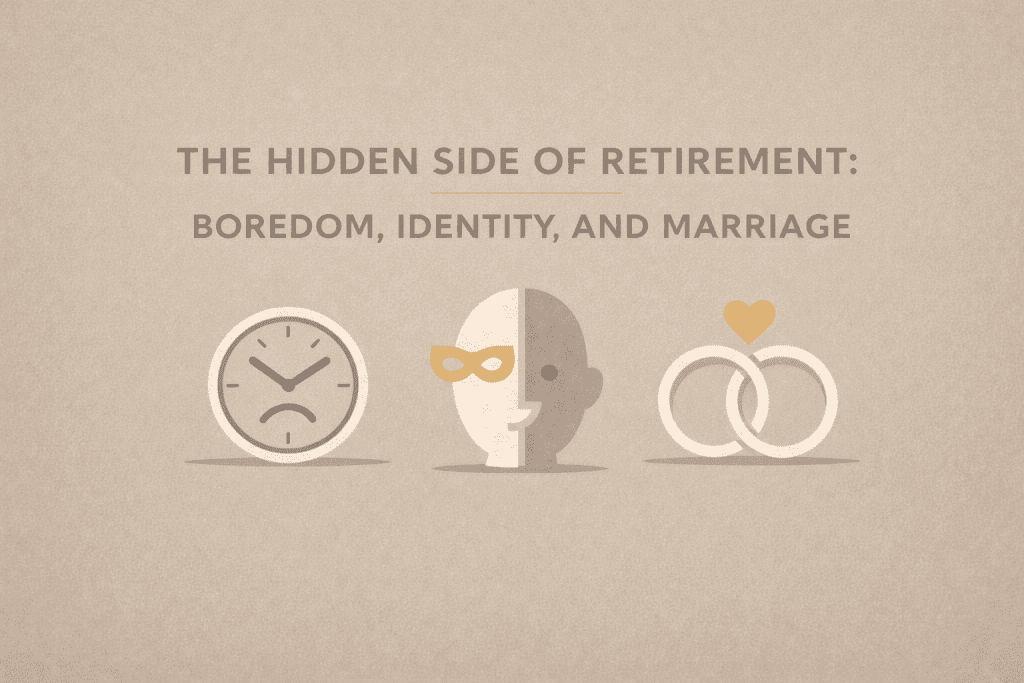
Retirement planning conversations usually orbit around money.
Net worth. Withdrawal rates. Social Security timing. Medicare enrollment windows.
All important.
But here’s what rarely makes the spreadsheet:
What happens to your identity when the title goes away?
What happens to your days when structure disappears?
What happens to your marriage when Tuesday looks like Saturday… and you’re both home?
Retirement isn’t just a financial transition.
It’s a psychological one.
And sometimes, a relational one.
The Identity Shift Nobody Warns You About
For decades, work quietly shaped your sense of self.
Even if you didn’t love your job, it provided:
- A role
- A routine
- A reason to get up
- A place where you were needed
You weren’t just “you.”
You were:
- The manager
- The owner
- The engineer
- The nurse
- The broker
- The problem-solver
Then one day, that role ends.
At first, it feels freeing.
No meetings. No deadlines. No Sunday-night dread.
But eventually, a quieter question creeps in:
Who am I now?
This isn’t melodrama. It’s normal.
Humans are wired for purpose and contribution. Work — even imperfect work — supplies both.
When it disappears, you have to replace it intentionally.
Not with busyness.
With meaning.
The Time Expansion Effect
Retirement expands time.
Massively.
The first few weeks feel like vacation. Sleep in. Long breakfasts. Unscheduled afternoons.
But vacation has an end date.
Retirement doesn’t.
Without anchors, days start to blur:
Monday looks like Thursday.
Tuesday feels like Saturday.
Weekends lose their edges.
For some, that’s heaven.
For others, it’s disorienting.
Structure isn’t the enemy of freedom.
It’s often what makes freedom sustainable.
People who thrive in retirement usually build light scaffolding into their weeks:
- A volunteer commitment
- A standing lunch
- A class
- A project
- A physical routine
Not to recreate a job.
But to create rhythm.
Drift feels relaxing at first.
Over time, it can feel hollow.
Boredom Is Data, Not Failure
Here’s something most retirees don’t say out loud:
“I’m bored.”
They feel guilty admitting it.
After all, wasn’t this the goal?
But boredom isn’t a character flaw.
It’s information.
It signals:
- You need challenge
- You miss contribution
- You crave growth
- You want to matter
That doesn’t mean you need another career.
It might mean:
- Mentoring
- Teaching
- Starting something small
- Creating something
- Learning something new
The goal isn’t constant stimulation.
It’s engagement.
There’s a difference.
Marriage: The Proximity Adjustment
Now let’s talk about the one nobody includes in the retirement calculator.
Marriage.
Or long-term partnership.
When one spouse retires before the other, there’s an adjustment.
When both retire? There’s a bigger one.
Suddenly:
- You’re both home
- There’s more shared space
- More shared decisions
- More shared air
Couples who spent decades running parallel workdays now share the same calendar.
That shift can be beautiful.
It can also require recalibration.
Questions start to surface:
- Who handles what now?
- How much togetherness feels good?
- How much independence is healthy?
Some couples grow closer.
Some discover friction that work schedules used to mask.
Retirement doesn’t create issues.
It reveals them.
The healthiest transitions usually include:
- Open conversation about expectations
- Individual space alongside shared time
- Shared projects — but not forced ones
Two people don’t need to retire into the same hobby.
They need mutual respect for how each designs their days.
The Emotional Transition Timeline
Most people underestimate the adjustment period.
There’s often a predictable arc:
- Euphoria — Freedom. Relief. Novelty.
- Disorientation — Lack of structure. Identity questions.
- Experimentation — Trying new rhythms.
- Stability — A new normal forms.
The mistake is assuming Phase 1 lasts forever.
It doesn’t.
And that’s okay.
Retirement is not a switch you flip.
It’s a season you grow into.
Designing Purpose on Purpose
If money funds retirement, purpose sustains it.
That doesn’t require something grand.
It might look like:
- Being the steady presence in your grandkids’ lives
- Serving your community
- Creating art, music, writing
- Staying physically strong
- Deepening friendships
It might be quieter than your career.
It might be more meaningful.
The key is choosing — not drifting.
A Personal Reflection
There’s a rhythm to the water just before sunrise.
You ease off the dock. The tide’s coming in. The world hasn’t fully woken up yet.
You’re not chasing anything.
But you’re not aimless either.
You’ve studied the conditions. You know where you’re headed. You’re intentional about where you cast.
Retirement works the same way.
Left unattended, it drifts.
Designed thoughtfully, it becomes something far richer than escape from work.
It becomes alignment.
The hidden side of retirement isn’t scary.
It’s simply human.
Plan for it the same way you planned for the money.
Because in the end, the spreadsheets matter.
But the life you build after them?
That matters more.




1 comment
First section l’ve read. Spot on. Well done.