Bottom line: When you claim Social Security is one of the few retirement decisions that’s permanent. File early and you lock in a smaller check for life. Wait and the check grows — but so does the risk you don’t collect it as long. The “right” answer depends on longevity, taxes, spousal dynamics, and how this fits with your broader income plan.
Let’s break it down in plain English.
1. Know Your Ages (and What They Mean)
There are three key milestones:
- 62 – Earliest you can claim retirement benefits.
- Full Retirement Age (FRA) – 66–67 depending on birth year.
- 70 – Latest age to claim; benefits stop growing after this.
If you were born in 1960 or later, your FRA is 67. Claiming at 62 reduces your benefit by about 30% compared to FRA. Waiting from FRA to 70 increases your benefit by 8% per year in delayed retirement credits.
That 8% is hard to beat with guaranteed, inflation-adjusted income. But it’s not free — you’re trading early cash flow for larger lifetime income later.
2. The Simple Math (Before We Complicate It)
Let’s say your FRA benefit is $3,000/month.
- Claim at 62 → about $2,100/month
- Claim at 67 (FRA) → $3,000/month
- Claim at 70 → about $3,720/month
That’s a 77% increase from 62 to 70.
The breakeven age (where waiting “wins”) is typically around 80–82. Live well into your 80s or 90s and delaying usually pays off. Don’t, and claiming earlier can look smarter.
You’re essentially making a longevity bet — on yourself.
3. Longevity Isn’t Just Genetics
If you’re healthy, active, and your family tends to stick around into their late 80s or 90s, delaying becomes more attractive.
But longevity isn’t just DNA. It’s:
- Financial stress
- Healthcare access
- Lifestyle
- Whether you’re still working
If you’re on the Texas coast fishing at sunrise and grilling redfish by noon, odds are you’re planning to be around a while. That matters.
4. Married? This Changes Everything
For couples, Social Security isn’t two separate decisions. It’s a coordinated strategy.
Key points:
- The higher earner’s benefit becomes the surviving spouse’s benefit.
- Delaying the higher earner’s claim increases the survivor’s lifetime income.
- Spousal benefits can be up to 50% of the higher earner’s FRA benefit.
In many cases, a strong strategy looks like:
- Lower earner claims earlier (if needed).
- Higher earner delays to 70.
Why? Because that larger check may last 20–30 years for the surviving spouse.
Social Security is longevity insurance — especially for widows and widowers.
5. Don’t Ignore Taxes
Up to 85% of Social Security benefits can be taxable, depending on your “combined income” (AGI + nontaxable interest + half your SS benefit).
Claiming earlier while still working can:
- Increase benefit taxation.
- Push you into higher brackets.
- Trigger IRMAA surcharges on Medicare premiums later.
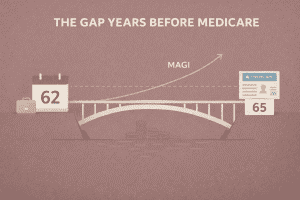
For many retirees, there’s a valuable planning window between retirement and age 70 where income is temporarily lower. That window can be used for:
- Roth conversions
- Capital gain harvesting
- IRA withdrawals at lower brackets
Delaying Social Security during those years often pairs beautifully with tax planning.
This is where claiming strategy stops being about Social Security and becomes about total retirement design.
6. Still Working? Be Careful Before FRA
If you claim before FRA and continue working, the earnings test applies.
In 2026, if you’re under FRA, Social Security withholds $1 for every $2 you earn above the annual limit (around the low-to-mid $20,000s — check current figures).
Once you hit FRA, the earnings test disappears.
This trips up a lot of people who claim at 62 thinking it’s “free money,” only to see benefits reduced because they’re still earning good income.
7. When Claiming Early Makes Sense
Despite all the math favoring delay, there are good reasons to claim at 62 or FRA:
- Health concerns or shorter life expectancy
- Need for income
- Single with limited longevity risk
- Large tax-deferred balances you plan to draw down anyway
- You simply value earlier cash flow more than maximizing later income
Retirement isn’t a spreadsheet exercise. It’s life design.
8. The “Sleep at Night” Factor
There’s a psychological side to this decision.
Some people love the idea of locking in the biggest possible guaranteed check. Others hate the thought of leaving money on the table if they don’t live long enough to collect it.
Both are valid.
The goal isn’t to “win” Social Security. It’s to integrate it into a broader, resilient income plan that covers:
- Fixed expenses with predictable income
- Variable spending with flexible assets
- Healthcare surprises
- Inflation
A Practical Framework
When deciding when to claim, walk through this:
- Longevity outlook – Realistically, how long might you live?
- Spousal impact – Who needs the higher survivor benefit?
- Tax window – Is this a low-income planning opportunity?
- Portfolio structure – Can your investments bridge to 70?
- Lifestyle priorities – What gives you peace of mind?
If delaying fits financially and emotionally, it’s often powerful.
If it doesn’t, claiming earlier isn’t a mistake — it’s a choice.
Social Security isn’t just about a start date. It’s about how this guaranteed, inflation-adjusted income anchors the rest of your retirement.
Get the timing right, and it quietly supports everything else.
Get it wrong, and you live with it for decades.
Choose thoughtfully.