If retirement were a fishing trip, income would be the tide.
You can have the prettiest boat, the best gear, and a cooler full of ambition—but if the water’s not moving, you’re not going anywhere.
That’s what this pillar is about: creating reliable, flexible income that supports your life instead of running it.
Not hustle-for-the-sake-of-hustle income. Not “watch the market every five minutes” income. Not “I guess I’ll just hope it works out” income.
Deliberate income.
What This Pillar Covers
The Income Pillar is about answering one deceptively simple question:
Where will your money come from in retirement—and how confident are you in that plan?
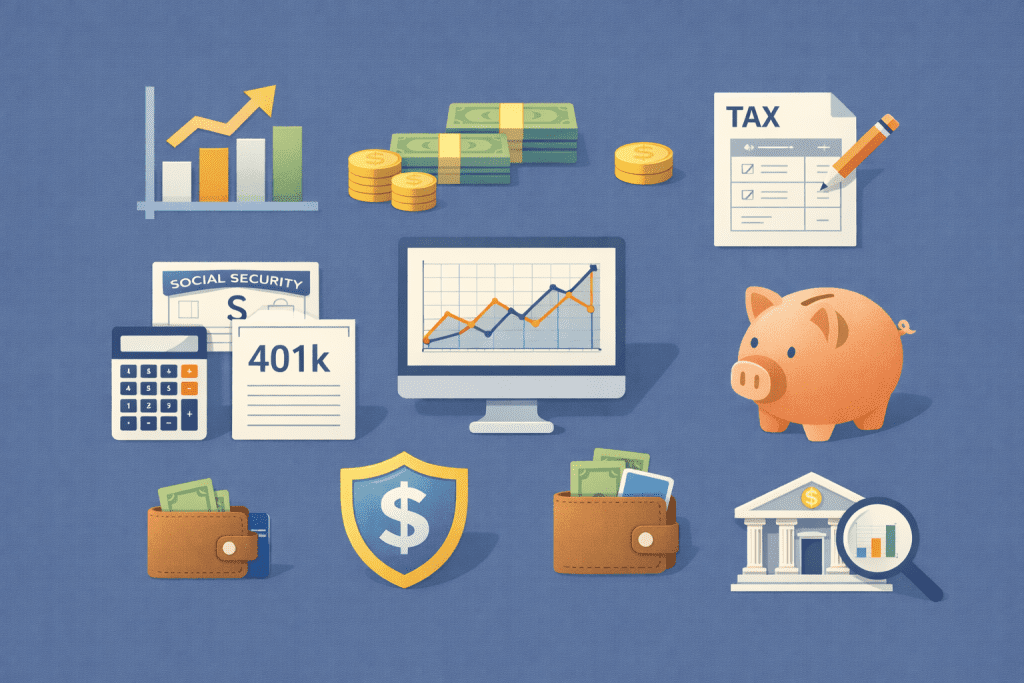
For most of us, income in retirement is a blend of:
- Social Security
- Portfolio withdrawals (taxable, traditional IRA, Roth)
- Pensions (if you’re one of the lucky few)
- Annuities (sometimes smart, sometimes not)
- Part-time work or consulting
- Rental or business income
The trick isn’t just having these sources. It’s orchestrating them.
Because in retirement, income isn’t just math. It’s sequencing, taxes, timing, and risk management—all layered together.
Income Is Not the Same as Net Worth
One of the biggest mindset shifts in retirement:
A $2 million portfolio does not automatically equal a $2 million lifestyle.
What matters isn’t the size of the pile. It’s how efficiently you can convert that pile into sustainable income.
That includes:
- Managing withdrawal rates
- Reducing sequence-of-returns risk
- Minimizing unnecessary tax drag
- Avoiding cliffs like IRMAA surcharges
- Coordinating income with Medicare and Social Security
In other words: this pillar talks to the Tax and Social Security pillars constantly. They’re fishing buddies. You don’t separate them.
The Big Decisions We’ll Tackle
Here’s what you’ll find inside the Income Pillar over time:
Withdrawal Strategy
Which accounts should you pull from first? When does Roth conversion make sense? How do you pay the tax bill without lighting your portfolio on fire?
Social Security Timing
Take it at 62? 67? 70? What changes if you’re married? What if health, longevity, or legacy goals complicate the picture?
Safe Spending
What’s “safe” anyway? Fixed percentage? Guardrails? Dynamic withdrawals? How much flexibility should you build into your plan?
Annuities & Guaranteed Income
When does guaranteed income add peace of mind? When does it just add fees?
Earning in Retirement
Consulting, part-time work, passion projects. Not because you have to—but because you might want to.
The Philosophy Behind This Pillar
I retired at 57.
Not because I hit some mythical “number,” but because I hit a level of clarity about what I wanted the next chapter to look like.
Income planning gave me options.
Options reduce stress. Stress reduction improves decision-making. Better decisions protect income.
See the loop?
This pillar isn’t about squeezing every last basis point out of a portfolio. It’s about designing income that:
- Covers essentials
- Supports the fun stuff
- Survives bad markets
- Lets you sleep
If your plan only works when markets go up, that’s not a plan. That’s optimism wearing a spreadsheet.
How to Use This Section
If you’re pre-retirement (say 55–65):
- Focus on sequencing, Roth strategy, and Social Security timing.
If you’re already retired:
- Focus on tax efficiency, guardrails, and sustainability.
If you’re somewhere in between:
- Welcome to the messy middle. That’s where most smart decisions get made.
Final Thought
Income in retirement isn’t about replacing a paycheck.
It’s about replacing certainty.
Your employer used to provide that. Now you do.
This pillar is where we build that certainty—calmly, methodically, and without drama.
Let’s get to work.
— JT —