Short version:
Retirement isn’t a reward. It’s a redesign. And the goal isn’t to “stay busy.” It’s to build a next chapter that fits your energy, your money, your relationships, and the way you actually want to spend a Tuesday morning.
You don’t need a bucket list. You need alignment.
Let’s talk about how to build it.
The Lie of the Highlight Reel
Most retirement marketing looks like a cruise brochure had a baby with a golf course.
Palm trees. Perfect sunsets. A suspicious number of white pants.
Here’s the problem: real life is less Instagram, more Tuesday at 10:17 a.m.
You’re not on vacation. You’re living. That means:
- Energy fluctuates.
- Family needs change.
- Markets move.
- Knees complain.
- Grandkids show up sticky.
If your next chapter is built on fantasy, it will collapse under ordinary life. Build it on reality, and it holds.
Step 1: Design for Energy, Not Age
Age is a number. Energy is a currency.
At 57, 67, or 77, the question isn’t “What should someone my age be doing?” It’s:
- When do I feel most alive?
- What drains me?
- What do I want more of?
- What do I want less of?
Some people want a second act career.
Some want part-time consulting.
Some want to fish at sunrise and read by 2 p.m.
None of those are more “impressive” than the others.
If your energy peaks in the morning, build mornings around what matters. If afternoons are your slow roll, protect them. A well-built next chapter respects your rhythm instead of fighting it.
Step 2: Anchor to Structure (Just Enough)
Freedom without structure turns into drift.
I’ve seen it happen. The first six months feel like a permanent Saturday. Then slowly, the days blur. The calendar empties. Motivation fades.
You don’t need a boss. But you probably need a rhythm.
That might look like:
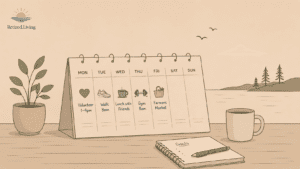
- A weekly volunteer commitment
- A standing lunch with friends
- A writing schedule
- A fishing tide chart (rising tide at sunrise? I’m gone)
Structure is scaffolding. It gives shape to freedom.
Too much structure feels like you never left work. Too little feels like you never arrived anywhere.
Step 3: Get Honest About Money (Without Letting It Run the Show)
Lifestyle decisions don’t live in a vacuum. They sit on top of your financial plan.
Questions worth asking:
- What does our baseline monthly spending actually look like?
- What’s “essential” vs. “optional”?
- How much flexibility do we want?
- What risks are we comfortable with?
A next chapter that fits real life doesn’t ignore money—but it doesn’t obsess over it either.
If you’ve built a solid income strategy—withdrawal plan, Social Security timing, tax awareness—then lifestyle becomes a design exercise, not a stress test.
Money should fund your life. Not dominate it.
Step 4: Decide Who You Are Now
This one sneaks up on people.
For decades, your identity may have been:
- Broker
- CEO
- Teacher
- Contractor
- Parent
- Caregiver
Then one day… you’re not that anymore. Or not in the same way.
Retirement doesn’t erase your identity, but it does untie it from your job title.
So who are you now?
- The mentor?
- The traveler?
- The artist?
- The grandparent who always shows up?
- The guy who finally learns acoustic guitar?
Your next chapter works best when it’s built on identity, not just activity.
“I play golf” is an activity.
“I value connection and being outdoors” is identity.
Build around identity. Activities will follow.
Step 5: Build Margin for the Unexpected
Here’s the part no brochure shows you.
Health events happen.
Parents age.
Kids boomerang.
Markets drop 20%.
Life does life.
A sustainable next chapter has margin:
- Financial margin (cash buffer, conservative assumptions)
- Calendar margin (not booked solid)
- Emotional margin (space to adapt)
If every dollar and every hour is spoken for, the first curveball feels like a crisis.
Leave room.
Step 6: Keep Growing (Even Slowly)
You don’t retire from growth.
You just get to choose the direction.
Maybe it’s:
- Learning something new
- Writing more
- Starting a small passion project
- Mentoring younger professionals
- Improving your health
Progress doesn’t have to be dramatic. It just has to exist.
A life without forward motion starts to feel smaller. A little growth—mental, physical, relational—keeps it expanding.
The Real Goal
The real goal isn’t excitement.
It’s congruence.
When your time, money, relationships, health, and identity are moving in roughly the same direction, life feels steady. Not flashy. Not frantic. Steady.
And steady is underrated.
One Simple Exercise
If you want something practical, try this:
Write down your ideal ordinary Tuesday.
Not vacation Tuesday. Not fantasy Tuesday.
Regular life Tuesday.
- When do you wake up?
- Who are you with?
- What are you doing at 10 a.m.?
- At 3 p.m.?
- After dinner?
If that day feels grounded, sustainable, and satisfying, you’re close.
If it feels exhausting or empty, adjust.
That’s the beauty of this stage. You get to edit.
You don’t need to prove anything in this next chapter. You don’t need applause. You don’t need hustle.
You need a life that fits.
And when it fits, it doesn’t feel like retirement.
It just feels like you.